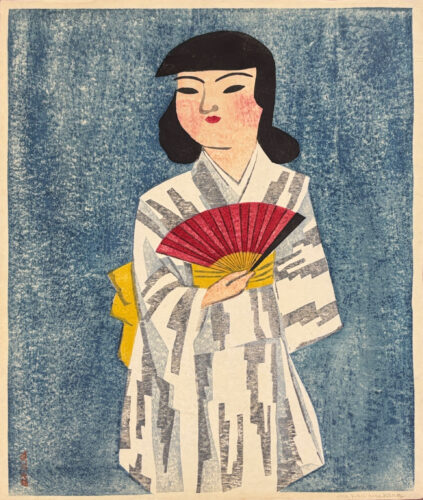
Maekawa Senpan
1888–1960
Japanese printmaker and cartoonist.
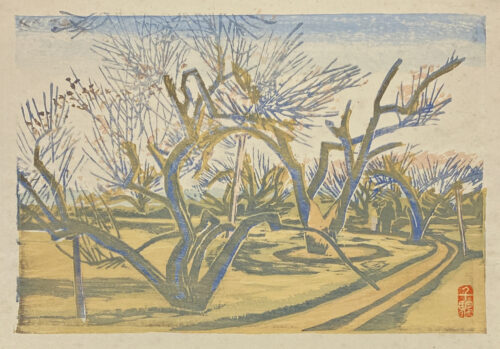
Maekawa Senpan was an important Japanese printmaker of the twentieth century and a major figure associated with the Sōsaku Hanga (Creative Print) movement. He was also active as a cartoonist and illustrator, producing works for newspapers and magazines throughout much of his career.
Born in Kyoto in 1888, Maekawa studied at the Kansai Bijutsuin, where he studied under the painters Asai Chū and Kanokogi Takeshirō. Around 1912, he moved to Tokyo and joined the publishing company of Tokyo Puck, the influential satirical magazine associated with cartoonist Kitazawa Rakuten. There he began working professionally as a cartoonist and illustrator.
He subsequently worked for the Keijō Nippō in Seoul and for the Yomiuri Shimbun in Tokyo, while continuing to develop his interest in printmaking. In 1919, he exhibited at the first exhibition of the Japanese Creative Print Association, marking the beginning of his sustained career as a print artist. He became a member of the association in 1922.
Maekawa participated in major Japanese exhibitions including the Bunten, Teiten, Shun'yō-kai exhibitions, and later the exhibitions of the Japan Print Association. He participated in the founding of the Japan Print Association in 1931 and continued exhibiting with the organization until his death.
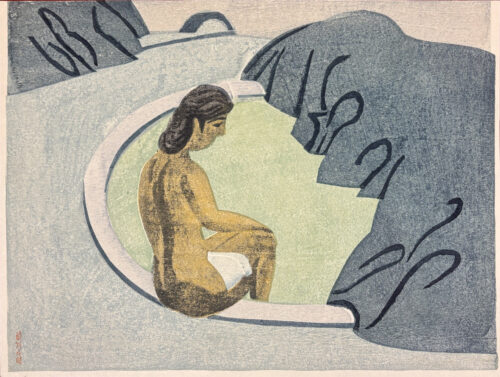
Among his best-known works are his urban landscapes and his extensive series depicting hot springs and bathing culture. His A Hundred Views of New Tokyo (Shin Tokyo Hyakkei) series captured various scenes of the modern city, while his Prints of Hot Springs (Hanga Yokusenpu) series explored bathing culture and everyday life at Japanese hot-spring resorts. The first volume of Hanga Yokusenpu was published in 1941, followed by several subsequent series.
Alongside his printmaking, Maekawa remained active as a cartoonist and illustrator. His popular serial cartoon “Awatemono no Kuma-san” (“The Absent-Minded Mr. Kuma”) became particularly well known. His experience as a cartoonist can also be seen in the lively characterization, humor, and attention to ordinary people that distinguish many of his prints.
After the Second World War, Maekawa continued to produce prints and returned to Tokyo in 1950, settling in Suginami. In 1960, he helped establish the print artists' group Nippankai and became an adviser to the Japan Print Association. He died in Tokyo on November 17, 1960, at the age of 72.
Artistic Characteristics
Maekawa's work is particularly notable for its warm and observant depiction of everyday life.
Rather than concentrating solely on grand historical subjects or idealized landscapes, he frequently portrayed:
urban streets and neighborhoods
railway stations and markets
hot-spring resorts
bathers
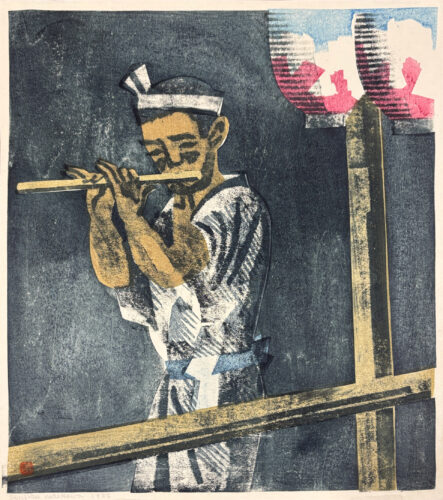
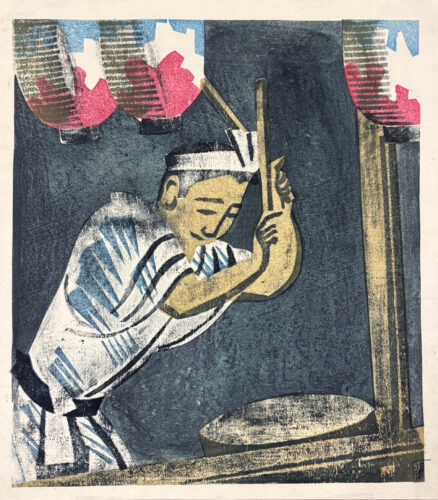
workers and ordinary people
travelers
everyday scenes of Japanese life
His prints combine the visual language of modern Japanese printmaking with a strong interest in ordinary life and traditional Japanese customs. The British Museum describes him as an independent personality within twentieth-century Japanese printmaking and emphasizes his interest in Japanese folk life and customs.