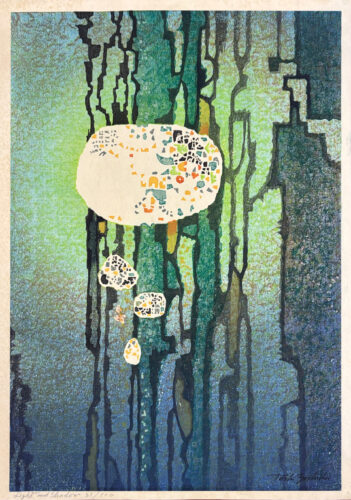
YOSHIDA Toshi
1911–1995 Born in Tokyo, Japan
Printmaker and painter
Yoshida Tōshi was an important Japanese printmaker who developed his career from the tradition of Shin-hanga (New Prints) toward the more individualistic approach of Sōsaku-hanga (Creative Prints). He is particularly known for his highly accomplished woodblock prints of wildlife, landscapes, and nature.
Yoshida was born in Tokyo on July 25, 1911. He was the eldest son of the renowned printmaker Yoshida Hiroshi and the artist Yoshida Fujio. His younger brother was the printmaker Yoshida Hodaka. He grew up in the Yoshida family's Tokyo studio, where he was surrounded by professional carvers and printers and became familiar with the traditional techniques of Japanese woodblock printing from an early age. His father began formally teaching him around the age of fourteen.
His early interest in animals is already evident in his works from the 1920s. The National Museum of Modern Art, Tokyo holds his color woodcuts Paddybirds (1927) and Ptarmigans (1930), demonstrating his considerable technical ability at a remarkably young age.
From 1932 to 1935, Yoshida studied at the Taiheiyo Art School, which had been established with the involvement of his father. He also continued to develop his skills as an oil painter. In 1938, he was accepted into the Taiheiyo-gakai exhibition.
Yoshida traveled extensively throughout his life. In 1930, he accompanied his father on a sketching trip through India, Burma, Malaysia and other parts of Southeast Asia. He later traveled to northeastern China and Korea, and before and after the Second World War visited Europe, Egypt, the United States, Mexico, Canada, Australia, and Africa. These journeys had a profound influence on his artistic interests and especially on his depictions of animals and natural environments.
From his father's tradition to his own style
Yoshida's early prints were strongly influenced by his father, Hiroshi Yoshida. Works from the 1930s through the early 1950s often display the refined naturalism and sophisticated multi-color woodblock techniques associated with his father's Shin-hanga style.
Following Hiroshi's death in 1950, Tōshi took over the family studio. However, he gradually moved beyond his father's artistic language. Around 1952, he began producing larger, more abstract prints in the spirit of Sōsaku-hanga, working without the assistance of the studio craftsmen.
This period marked an important turning point in his career. Alongside his naturalistic landscapes, he experimented with abstract compositions, strong areas of color, and increasingly personal approaches to the woodblock medium.
Wildlife and nature
The most distinctive part of Yoshida's mature career is his extensive body of wildlife prints.
He traveled widely to observe animals in their natural environments, particularly in Africa and North America. His subjects include lions, elephants, giraffes, zebras, tigers, bears, birds, and many other species. Rather than depicting animals as isolated subjects, Yoshida frequently placed them within expansive landscapes, emphasizing the relationship between the animal and its environment.
His approach combines the precision of traditional Japanese woodblock printing with a modern interest in composition, color, and the natural world. This helped distinguish his animal prints from the conventional landscape tradition inherited from his father.
Yoshida also produced a wide variety of other works, including abstract designs, landscapes, portraits, and illustrated books. His 20-volume Animal Picture Book Series became an important part of his artistic legacy and reflected his lifelong interest in wildlife.
International recognition
Yoshida's work was widely exhibited outside Japan. In 1952–53, he traveled to the United States and Europe, where he exhibited his work and lectured on Japanese woodblock printing. In 1954, he taught printmaking at the Art Institute of Chicago. He subsequently participated in international print exhibitions in countries including Australia, Mexico, Canada, and the United States.
He participated in the Tokyo International Biennale of Prints between 1957 and 1962 and exhibited at international print exhibitions including those in Lugano. His works are now held in museum collections around the world.
Yoshida continued to work until his later years. He died in Tokyo on July 1, 1995, at the age of 83.