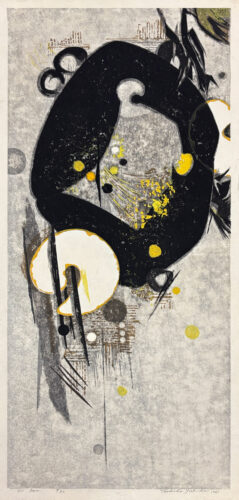
Hodaka Yoshida (1926–1995) was a Japanese printmaker who expanded the possibilities of woodblock printing by incorporating photographic processes and a wide range of modern printmaking techniques. Born in Tokyo, he was the second son of the renowned painter and printmaker **Hiroshi Yoshida**. He belonged to the distinguished Yoshida family of artists, which played an important role in the development of modern Japanese printmaking.
Yoshida initially worked in oil painting, exhibiting at the Nihon Independent Exhibition and the Taiheiyō Art Association from the late 1940s. In 1952, he was accepted into the Japan Print Association Exhibition with a woodblock print and subsequently became a member of the association. His early woodcuts gradually moved away from traditional representation toward increasingly abstract forms.
In 1955, Yoshida traveled to the United States, Cuba, and Mexico with his elder brother Toshi Yoshida. His encounter with the ruins and visual culture of the ancient Maya civilization had a profound influence on his work, leading him to develop a more abstract and dynamic visual language. The following year, he received Third Prize at the inaugural Shell Art Award.
Travel remained an important source of inspiration throughout his career. In 1957, Yoshida traveled around the world with his mother Fujio Yoshida and his wife Chizuko Yoshida, giving lectures and exhibitions on woodblock printing along the way. He subsequently visited more than forty countries, photographing and observing the walls, fences, buildings, signs, and other fragments of everyday life he encountered. These images became an important source for his later artistic development.
A decisive turning point came during his visit to the United States in 1963, when Yoshida encountered **Pop Art** and began incorporating photographic processes into his prints. He developed an innovative technique combining woodblock printing with photo-based processes, and subsequently experimented with lithography, silkscreen, etching, collage, and metal plate techniques. His approach allowed photographic imagery, abstract forms, and the tactile qualities of woodblock printing to coexist within a single composition.
Throughout the 1960s and 1970s, Yoshida exhibited extensively in Japan and internationally, participating in major international print biennales and exhibitions in cities including Lugano, Ljubljana, Kraków, and Rijeka. In 1987, he received the Gen Yamaguchi Grand Prize, and in 1990 he was awarded the **Medal with Purple Ribbon**, one of Japan's major cultural honors.
In his later years, Yoshida became particularly interested in walls and architectural surfaces. Rather than depicting famous landmarks, he focused on ordinary fragments of the urban environment, transforming them into complex compositions in which photographic imagery, color, texture, and abstract forms overlap. His later works demonstrate his continued exploration of the relationship between the physical world and the images created from it.
Hodaka Yoshida died in Tokyo in 1995 at the age of 69. His work is held in the collections of museums in Japan and abroad, and he is recognized as an important figure in postwar Japanese printmaking, particularly for his pioneering use of photographic processes in combination with traditional woodblock techniques.