ONOSATO Toshinobu
1912–1986
Real name: Toshinobu Onosato
Born in Iida, Nagano Prefecture, Japan
Painter and printmaker
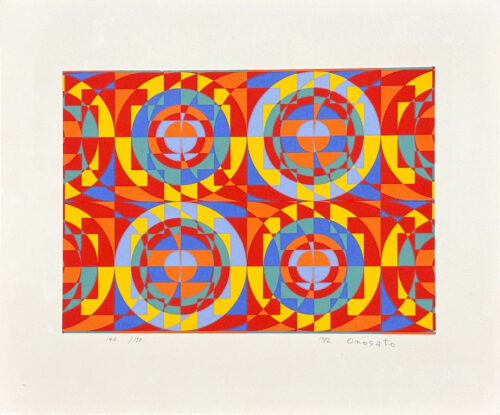
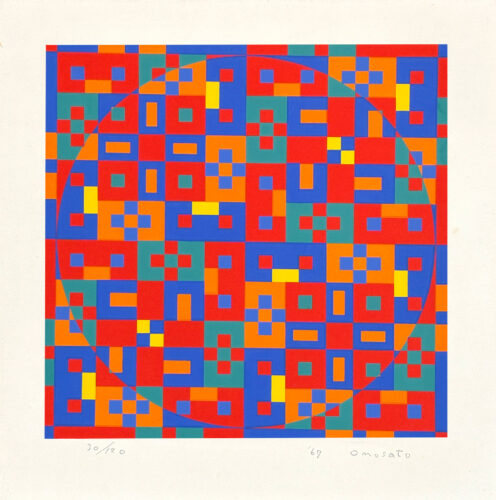
ONOSATO Toshinobu was a major Japanese abstract artist of the postwar period. He is particularly known for his highly distinctive geometric compositions based on circles, repeated forms, and optical effects, and he also produced lithographs and screenprints throughout his career.
Born on June 8, 1912, in Iida, Nagano Prefecture, Onosato moved to Kiryū, Gunma Prefecture, around 1922. He initially studied electrical engineering at Nihon University but left the university and subsequently studied painting at the Tsuda Seifū Western Painting School. In 1935, he was accepted into the 22nd Nika Exhibition.
In 1937, Onosato participated in the establishment of the Free Artists Association (Jiyū Bijutsu Kyōkai). He was associated with a number of avant-garde artists and writers of the period, including Saburō Hasegawa and Seikyu Eikyu. He also co-founded the art journal Dōjidai, expanding his activities beyond painting into the broader avant-garde art movement.
During the late 1930s and early 1940s, Onosato developed increasingly abstract and constructivist works. His 1940 painting Black Circle attracted attention for its unusual geometric structure. In 1942, however, he was conscripted into the military and sent to Manchuria. Following the end of the Second World War, he was detained by Soviet forces and spent approximately three years in a Siberian prison camp before returning to Japan in 1948.
After returning to Japan, he worked briefly as an art teacher while continuing his artistic practice. Around 1952, he began using the name “ONOSATO Toshinobu”, written in katakana, rather than his real name. He held his first solo exhibition in Tokyo in 1955.
The defining feature of Onosato's mature work is his repeated use of the circle. Rather than simply depicting circles as geometric forms, he arranged circles, semicircles, colors, and repeated shapes to create complex visual relationships and optical effects. The resulting compositions can appear to move, expand, contract, or shift depending on the viewer's perception.
The National Museum of Modern Art, Kyoto describes his work as creating a distinctive pictorial space through optical and perceptual structures, noting that he continued to explore the motif of the circle throughout his career.
His international recognition increased during the late 1950s and 1960s. In 1960, he participated in Abstract Art in Japan in Washington. In 1963, he received the Grand Prize at the 7th International Art Exhibition of Japan for Similarity. The following year, he participated in the Guggenheim International Award Exhibition and the 32nd Venice Biennale, and one of his works was acquired by the Solomon R. Guggenheim Museum.
From 1965 to 1967, his work was included in New Japanese Painting and Sculpture, a major exhibition that toured museums in the United States. He subsequently exhibited internationally and became recognized as one of the leading figures in the development of Japanese abstract painting.
Onosato also produced a significant body of lithographs and screenprints. Works such as CIRCLE 64-G, CIRCLE 66-B, and his 1971 screenprints are held in Japanese museum collections.
On November 30, 1986, Onosato died of acute pneumonia at his home in Kiryū, Gunma Prefecture, at the age of 74.