HASHIMOTO Okiie
1899–1993
Born in Tottori Prefecture, Japan
Japanese woodblock printmaker
Hashimoto Okiie was a prominent Japanese woodblock printmaker active from the prewar period through the postwar era. He is particularly known for his woodblock prints of Japanese castles, gardens, and landscapes, and served as president of the Japan Print Association from 1974 to 1980.
Hashimoto was born on October 4, 1899, in Tottori Prefecture. After graduating from the Tottori Normal School in 1920, he initially worked as an elementary school teacher. In 1921, he entered the teacher-training program at the Tokyo School of Fine Arts, graduating in 1924. He subsequently taught at the Toyama Prefectural Women's Normal School and affiliated high school before moving to Tokyo, where he taught at Tokyo Prefectural First Girls' High School until 1956.
Hashimoto originally studied Western-style oil painting, but developed an interest in printmaking in the early 1930s. In 1936, he attended a short woodblock-printing course taught in Tokyo by the printmaker Hiratsuka Un'ichi. This was his only formal training in woodblock printmaking. Hashimoto subsequently became a close friend of Hiratsuka and participated in his artistic circle, known as the Yoyogi-ha.
In 1937, Hashimoto made his first appearances at both the Kokuga-kai Exhibition and the Japan Print Association Exhibition. His works Nagoya Castle and Osaka Castle were selected for the Kokuga-kai exhibition that year, establishing the Japanese castle as one of the central subjects of his artistic practice. He also began exhibiting at the Shin-Bunten in 1938.
Hashimoto was also associated with Onchi Kōshirō's Ichimoku-kai (First Thursday Society). His work Yaene on Hachijō Island was included in Ichimokushū, the group's final portfolio published in 1950. Through these networks, he became closely connected with important figures in the Japanese Sōsaku Hanga (Creative Print) movement.
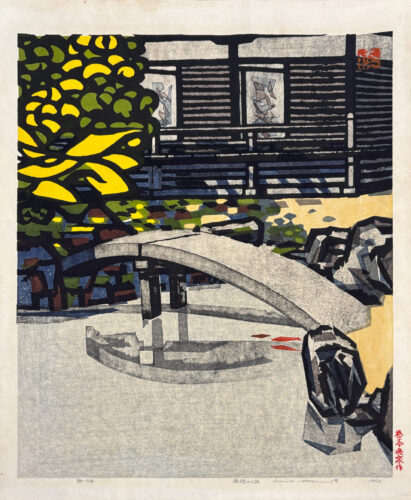
A central theme throughout Hashimoto's career was the Japanese castle and garden. Rather than simply documenting architecture, he transformed castles, stone walls, gates, trees, and gardens into carefully organized compositions. His prints often combine multiple viewpoints, simplified decorative forms, controlled geometry, and the effects of light and shadow. His depictions of Japanese dry gardens in particular balance a contemplative atmosphere with strong geometric structures and repeated forms.
In 1944, he published the illustrated book Nihon no Shiro (Japanese Castles), with text by architectural historian Kishida Hideto. After the war, he published Kojō Jikkei (Ten Views of Old Castles) in 1946 and later produced further collections devoted to Japanese castles. These publications contributed significantly to his reputation as a printmaker of Japanese historical architecture.
Hashimoto's international recognition grew during the postwar period. He exhibited at the 1st Tokyo International Biennale of Prints in 1957 with Hishi-no-mon (Hishi Gate). He subsequently participated in the Rome Exhibition of Contemporary Japanese Prints in 1961, the International Print Biennial in Lugano in 1962, and the Stockholm Exhibition of Contemporary Japanese Prints in 1964.
From 1974 to 1980, Hashimoto served as President of the Japan Print Association. He received the Konjuhōshō (Medal with Dark Blue Ribbon) in 1971 and the Order of the Rising Sun, Gold Rays with Rosette in 1980.
In his later years, Hashimoto donated substantial groups of his works to public museums. In 1987, he donated major collections to the Ehime Prefectural Museum of Art and the Tottori Prefectural Museum, followed in 1988 by a donation of 199 works to Sakaiminato City in Tottori Prefecture.
Hashimoto died on August 18, 1993, in Tokorozawa, Saitama Prefecture, at the age of 93