MAKI Haku
1924–2000
Born Maejima Tadaaki
Ibaraki Prefecture, Japan
Printmaker
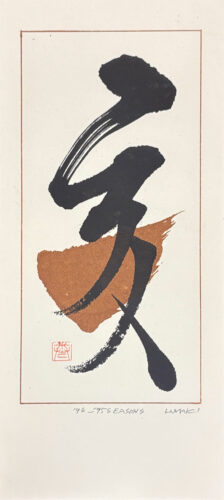
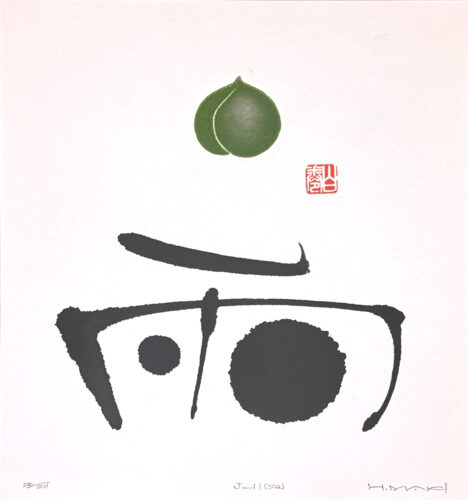
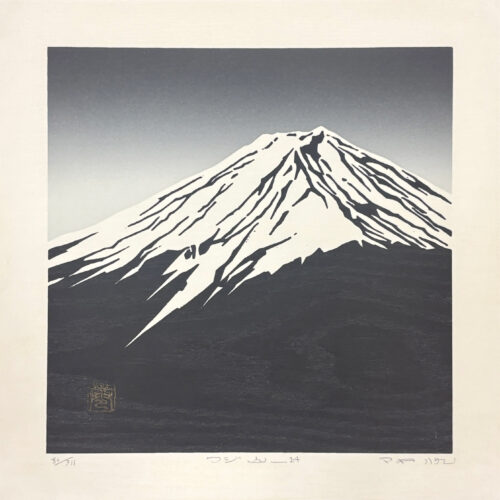
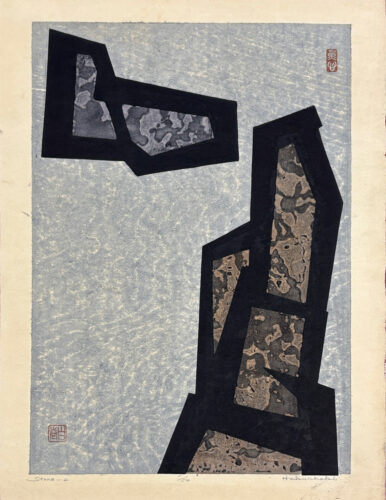
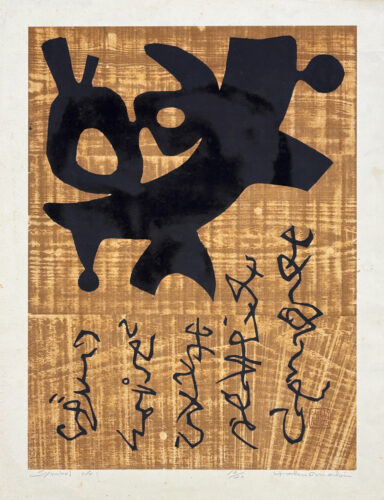
Maki Haku was one of the most distinctive Japanese printmakers of the postwar period and an important figure in the Sōsaku Hanga (Creative Print) movement. He is particularly known for his abstracted representations of kanji and seal-script characters, deeply embossed surfaces, cement-relief printing techniques, and vivid colors.
Maki was born on September 27, 1924, in Asomachi, Ibaraki Prefecture, under the name Maejima Tadaaki. Unlike many Japanese print artists of his generation, he did not receive formal training at an art school. After the Second World War, he moved to Tokyo and became involved with the Ichimoku-kai (First Thursday Society), a group associated with the pioneering modernist printmaker Onchi Kōshirō. Maki became one of Onchi's youngest pupils, and his early work shows a strong influence of Onchi's approach to modern Japanese printmaking.
While working as an educator after the war, Maki continued developing his printmaking practice. He first exhibited with the Japan Print Association in 1957 and became a member of the association in 1958.
In his early work, Maki frequently used kanji and ancient Chinese seal-script forms as visual motifs. Rather than treating these characters simply as written language, however, he transformed them into abstract compositions of line, shape, space, and rhythm. In 1966, Maki described his aim as giving the cultural heritage of ideographic characters a modern sensibility, reflecting his interest in reinterpreting Japanese and East Asian calligraphic traditions through contemporary printmaking.
During the 1960s, Maki developed the technique that would become one of the defining characteristics of his work. He applied cement to carved woodblocks, creating a raised and textured printing surface. After the cement hardened, he carved, sanded, and worked the surface further before printing it onto paper. The resulting prints possess unusually deep embossing and a strongly tactile, almost sculptural quality. He also experimented with oil-based pigments, lamination, and other mixed-media processes.
This process transformed the traditional woodblock print into a highly material object. The viewer encounters not only an image but also the physical surface of the paper, its relief, shadows, texture, and interaction with light. Bright colors, metallic effects, and deeply impressed forms give Maki's prints a presence that often approaches sculpture.
Among his best-known series are Poem, Festive Wine, Collection, and Dance. In 1968–69, Maki created 21 woodblock prints for Festive Wine, a deluxe publication featuring ancient Japanese poems dating from the fifth to ninth centuries. The project represents an important example of his transformation of traditional Japanese literary and calligraphic culture into modern visual form.
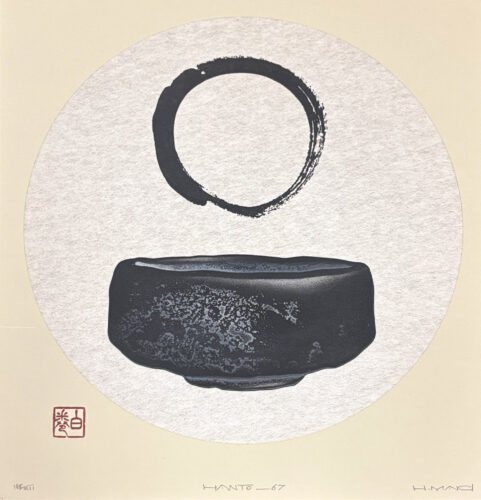
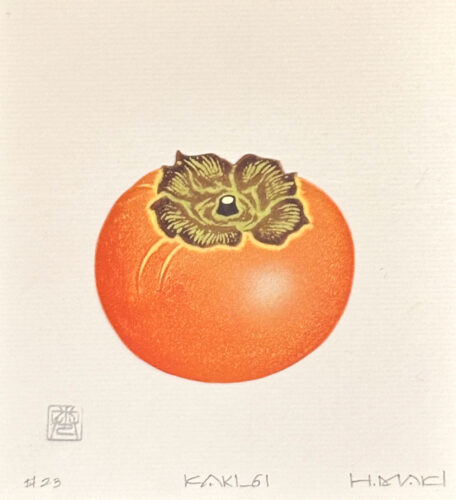
From the 1970s onward, Maki expanded his subject matter beyond kanji and abstract calligraphic forms. He produced works depicting persimmons, ceramic vessels, tea bowls, tortoises, and other traditional Japanese subjects, while maintaining his characteristic embossed surfaces, bold colors, and simplified compositions.
Over a career of nearly fifty years, Maki is estimated to have produced approximately 2,000 different print designs. His works are held in major collections around the world, including the Museum of Modern Art, New York; Art Institute of Chicago; Museum of Fine Arts, Boston; Philadelphia Museum of Art; Los Angeles County Museum of Art; and the British Museum.